counter

Tuesday, 30 October 2018
RECESSION 2020 PREDICTIONS
There is also acceleration in predictions of Recession in 2020 that might focus minds on how EU might be severely tested? Not all is original thinking or own analysis; they echo each other. But, that there is a tsunami of this thinking is beyond question and that the forecast could become true is strong likelihood.
2020 Global Recession: much media speculation about impending global crash and the fallout . Some of the predictions are by famous economists offering further bad news for all, merely recession may be optimistic. I’ve been predicting 2020 for a decade.
Predictions risk a self-fulfilling prophecy including that 2020 will be similar scale crash to 2008/9 wreaking similar or worse havoc again. This is why government treasuries & central banks never issue such forecasts even if they believe in them, for fear of being thereby responsible for a recession-causing panic reaction.
The Independent: “Next global financial crisis will strike in 2020, warns investment bank JPMorgan – sparked by automated trading systems.”1
· The Guardian “we are due a recession in 2020…”2 from Project Syndicate
· Forbes: “2020s Might Be The Worst Decade In U.S. History – triggered by contagion from a global credit crisis.”3
· Mark Zandi, chief economist Moody’s, “2020 is a real inflection point.”
· Investopedia: housing crash 20204
· Big Think, “…Economists: Second-longest …boom in … ends in 2020…”5
· US national Assoc. Business Economists “recession in 2020…”6
· Market Watch, “…selling your home? Do it before 2020…”7
· Yahoo Finance, “…monetary policy likely cause next recession”…”8
Guggenheim Investment "...next recession...start in late 2019..."9
_____________________________________________________
Newspapers, magazines, credit agencies & others’ References
1. Stubbly, P (2018), “Next Global Financial Crisis Will Strike In 2020, Warns Investment Bank Jpmorgan,” The Independent, https://www.independent.co.uk/news/business/news/next-financial-crisis-2020-recession-world-markets-jpmorgan-a8540341.html.
2. https://www.theguardian.com/business/2018/sep/13/recession-2020-financial-crisis-nouriel-roubini
3. Mauldin, J (2018), “The 2020s Might Be The Worst Decade In U.S. History,” Forbes, https://www.forbes.com/sites/johnmauldin/2018/05/24/the-2020s-might-be-the-worst-decade-in-u-s-history/#1fd316e448d3.
4. https://www.investopedia.com/investing/next-housing-recession-2020-predicts-zillow/
And Roubini, N (2018), “The Makings of a 2020 Recession and Financial Crisis,” Project Syndicate, https://www.project-syndicate.org/commentary/financial-crisis-in-2020-worse-than-2008-by-nouriel-roubini-and-brunello-rosa-2018-09.
5. Big Think https://bigthink.com/brandon-weber/economists-second-longest-economic-boom-in-u-s-history-ends-in-2020-with-a-recession
6. NABE http://fortune.com/2018/06/04/recession-2020-trump-trade/
7. https://www.marketwatch.com/story/economists-say-homes-could-go-on-sale-in-2020-when-the-next-recession-hits-2018-05-22
8. https://finance.yahoo.com/news/experts-predict-next-recession-begin-120000251.html
9. https://www.guggenheiminvestments.com/perspectives/macroeconomic-research/forecasting-the-next-recession
10. White, W (2018), “Bad Moon Rising,” Project Syndicate, https://www.project-syndicate.org/commentary/global-economy-weak-fundamentals-by-william-white-2018-10
11. Prins, N (2018), “4 Pillars of Debt in Danger of Collapse,” Daily Reckoning, https://dailyreckoning.com/pillars-debt-danger-of-collapse/
Countless others could be cited.


Friday, 23 September 2016
VISA-FREEDOM FOR BRITISH PASSPORT HOLDERS?
Of all the world's passports a British Passport provides visa-free access to more countries than any other, to 186 countrie, which is most of the world. The next best Visa-free passports provide access to 170 or less. When the UK resigns its EU membership it conceivably risks losing access to 27, supposing the rest of the EU plays hardball in retaliation for the UK restricting the free movement of EU nationals to come to the UK?
 British Passports will eventually require a re-design to remove references to EU membership. While that and any travel restrictions in EU may be irritating, to go where currently far more British citizens travel to than elsewhere in the world, perhaps less irritating than loss of "passporting" rights to UK based businesses.
Insurers, banks, and other financial services, half of whom are UK domiciled, that account for nearly half of the UK's trade, many rely on passporting rights to do cross-border business in the EU. Loss of EU membership and of The Single market would frustrate UK based goods manufacturers, who account for the other half of the UK's trade, of which 60% is currently with the EU, also ony half of whom are UK-domiciled. Ten per cent of UK trade in goods and services is with Ireland. Maybe there will be special arrangements in this case, but possibly not any longer allowable post-Brexit.
Companies can re-register their domicile in say Estonia, Cyprus, or Malta and manage their business remotely from the UK. That may not work for very large companies who may have to genuinely move their head offices into an EU country, which then becomes their principal tax jurisdiction.
Ten per cent of British citizens in the UK may qualify for Irish passports and thereby gain EU and or dual citizenship.
Others sufficiently desperate can take up residence in another EU country and gain citizenship after five years or marry an EU citizen. Irish dowry prices just went up?
It has to be a curious exchange that fifty million British citizens will lose a large amount of their freedom of travel only so that they in turn can restrict that of a few hundred thousands of foreign visitors to the UK and perhaps impose irritating visa requirements on 22 million visitors from the EU. They may feel some compensation, however, because of the lower pound exchange rate.
Brexiteers argue that free access to EU markets will most likely continue because the EU has a large trade surplus with the UK. That cannot continue, however, if EU imports into the UK will become, as they already have done, 10 per cent more expensive. Hence, there is already less to lose by not granting the UK full or free tradeing rights in the EU, which anyway will thereby save itself much or most or all the UK's trade surplus in financial and other services. The UK has a trade surplus with Ireland in both goods and services. ireland a large trade surplus with the rest of the world but a deficit in capital flows with the UK, and may therefore improve its balance of payments by no longer permitting either of the UK's surpluses to continue, on top of which it stands to attract a lot of UK businesses seeking to re-domicile within the EU?
While the sovereignty of borders in today's globalised world can offer little or no political-economy protection when there is free movement of capital across borders, sovereignty can make a difference to trade. The UK already has a high trade deficit of about 6% ratio to GDP in goods with very few sectors earning a significant or any trade surplus except finaancial and related services. The UK therefore will have to rely far more than in the past on voluntary inflow of private capital than annually for decades has been wporth about 2% ratio to GDP. But that is equivalent to borrowing and to selling net financial and property assets.
For UK trade to take advantage of lower exchange rate and balance its external account better will require exports of goods to grow much faster than not only imports of goods but much faster than the likely shrinkage in UK exports of financial and related services. It is not hard to imagine the UK having to increase its borrowing (in hard currencies) from the rest of the world for years at an annual rate of about 5% ratio to GDP, and especially if UK banks persist in their four decades old habit of not growing lending to businesses but only to property and for mortgages such that today for every £1 lent to businesses, UK banks lend £6 for mortgages! If this continues there will be no prospect of the UK outside the EU becoming better able to pay its way in the world. It will become a massive nebt debtor, hardly a good foundation or recipe for economic independence and negotiating trade deals?
British Passports will eventually require a re-design to remove references to EU membership. While that and any travel restrictions in EU may be irritating, to go where currently far more British citizens travel to than elsewhere in the world, perhaps less irritating than loss of "passporting" rights to UK based businesses.
Insurers, banks, and other financial services, half of whom are UK domiciled, that account for nearly half of the UK's trade, many rely on passporting rights to do cross-border business in the EU. Loss of EU membership and of The Single market would frustrate UK based goods manufacturers, who account for the other half of the UK's trade, of which 60% is currently with the EU, also ony half of whom are UK-domiciled. Ten per cent of UK trade in goods and services is with Ireland. Maybe there will be special arrangements in this case, but possibly not any longer allowable post-Brexit.
Companies can re-register their domicile in say Estonia, Cyprus, or Malta and manage their business remotely from the UK. That may not work for very large companies who may have to genuinely move their head offices into an EU country, which then becomes their principal tax jurisdiction.
Ten per cent of British citizens in the UK may qualify for Irish passports and thereby gain EU and or dual citizenship.
Others sufficiently desperate can take up residence in another EU country and gain citizenship after five years or marry an EU citizen. Irish dowry prices just went up?
It has to be a curious exchange that fifty million British citizens will lose a large amount of their freedom of travel only so that they in turn can restrict that of a few hundred thousands of foreign visitors to the UK and perhaps impose irritating visa requirements on 22 million visitors from the EU. They may feel some compensation, however, because of the lower pound exchange rate.
Brexiteers argue that free access to EU markets will most likely continue because the EU has a large trade surplus with the UK. That cannot continue, however, if EU imports into the UK will become, as they already have done, 10 per cent more expensive. Hence, there is already less to lose by not granting the UK full or free tradeing rights in the EU, which anyway will thereby save itself much or most or all the UK's trade surplus in financial and other services. The UK has a trade surplus with Ireland in both goods and services. ireland a large trade surplus with the rest of the world but a deficit in capital flows with the UK, and may therefore improve its balance of payments by no longer permitting either of the UK's surpluses to continue, on top of which it stands to attract a lot of UK businesses seeking to re-domicile within the EU?
While the sovereignty of borders in today's globalised world can offer little or no political-economy protection when there is free movement of capital across borders, sovereignty can make a difference to trade. The UK already has a high trade deficit of about 6% ratio to GDP in goods with very few sectors earning a significant or any trade surplus except finaancial and related services. The UK therefore will have to rely far more than in the past on voluntary inflow of private capital than annually for decades has been wporth about 2% ratio to GDP. But that is equivalent to borrowing and to selling net financial and property assets.
For UK trade to take advantage of lower exchange rate and balance its external account better will require exports of goods to grow much faster than not only imports of goods but much faster than the likely shrinkage in UK exports of financial and related services. It is not hard to imagine the UK having to increase its borrowing (in hard currencies) from the rest of the world for years at an annual rate of about 5% ratio to GDP, and especially if UK banks persist in their four decades old habit of not growing lending to businesses but only to property and for mortgages such that today for every £1 lent to businesses, UK banks lend £6 for mortgages! If this continues there will be no prospect of the UK outside the EU becoming better able to pay its way in the world. It will become a massive nebt debtor, hardly a good foundation or recipe for economic independence and negotiating trade deals?
 British Passports will eventually require a re-design to remove references to EU membership. While that and any travel restrictions in EU may be irritating, to go where currently far more British citizens travel to than elsewhere in the world, perhaps less irritating than loss of "passporting" rights to UK based businesses.
Insurers, banks, and other financial services, half of whom are UK domiciled, that account for nearly half of the UK's trade, many rely on passporting rights to do cross-border business in the EU. Loss of EU membership and of The Single market would frustrate UK based goods manufacturers, who account for the other half of the UK's trade, of which 60% is currently with the EU, also ony half of whom are UK-domiciled. Ten per cent of UK trade in goods and services is with Ireland. Maybe there will be special arrangements in this case, but possibly not any longer allowable post-Brexit.
Companies can re-register their domicile in say Estonia, Cyprus, or Malta and manage their business remotely from the UK. That may not work for very large companies who may have to genuinely move their head offices into an EU country, which then becomes their principal tax jurisdiction.
Ten per cent of British citizens in the UK may qualify for Irish passports and thereby gain EU and or dual citizenship.
Others sufficiently desperate can take up residence in another EU country and gain citizenship after five years or marry an EU citizen. Irish dowry prices just went up?
It has to be a curious exchange that fifty million British citizens will lose a large amount of their freedom of travel only so that they in turn can restrict that of a few hundred thousands of foreign visitors to the UK and perhaps impose irritating visa requirements on 22 million visitors from the EU. They may feel some compensation, however, because of the lower pound exchange rate.
Brexiteers argue that free access to EU markets will most likely continue because the EU has a large trade surplus with the UK. That cannot continue, however, if EU imports into the UK will become, as they already have done, 10 per cent more expensive. Hence, there is already less to lose by not granting the UK full or free tradeing rights in the EU, which anyway will thereby save itself much or most or all the UK's trade surplus in financial and other services. The UK has a trade surplus with Ireland in both goods and services. ireland a large trade surplus with the rest of the world but a deficit in capital flows with the UK, and may therefore improve its balance of payments by no longer permitting either of the UK's surpluses to continue, on top of which it stands to attract a lot of UK businesses seeking to re-domicile within the EU?
While the sovereignty of borders in today's globalised world can offer little or no political-economy protection when there is free movement of capital across borders, sovereignty can make a difference to trade. The UK already has a high trade deficit of about 6% ratio to GDP in goods with very few sectors earning a significant or any trade surplus except finaancial and related services. The UK therefore will have to rely far more than in the past on voluntary inflow of private capital than annually for decades has been wporth about 2% ratio to GDP. But that is equivalent to borrowing and to selling net financial and property assets.
For UK trade to take advantage of lower exchange rate and balance its external account better will require exports of goods to grow much faster than not only imports of goods but much faster than the likely shrinkage in UK exports of financial and related services. It is not hard to imagine the UK having to increase its borrowing (in hard currencies) from the rest of the world for years at an annual rate of about 5% ratio to GDP, and especially if UK banks persist in their four decades old habit of not growing lending to businesses but only to property and for mortgages such that today for every £1 lent to businesses, UK banks lend £6 for mortgages! If this continues there will be no prospect of the UK outside the EU becoming better able to pay its way in the world. It will become a massive nebt debtor, hardly a good foundation or recipe for economic independence and negotiating trade deals?
British Passports will eventually require a re-design to remove references to EU membership. While that and any travel restrictions in EU may be irritating, to go where currently far more British citizens travel to than elsewhere in the world, perhaps less irritating than loss of "passporting" rights to UK based businesses.
Insurers, banks, and other financial services, half of whom are UK domiciled, that account for nearly half of the UK's trade, many rely on passporting rights to do cross-border business in the EU. Loss of EU membership and of The Single market would frustrate UK based goods manufacturers, who account for the other half of the UK's trade, of which 60% is currently with the EU, also ony half of whom are UK-domiciled. Ten per cent of UK trade in goods and services is with Ireland. Maybe there will be special arrangements in this case, but possibly not any longer allowable post-Brexit.
Companies can re-register their domicile in say Estonia, Cyprus, or Malta and manage their business remotely from the UK. That may not work for very large companies who may have to genuinely move their head offices into an EU country, which then becomes their principal tax jurisdiction.
Ten per cent of British citizens in the UK may qualify for Irish passports and thereby gain EU and or dual citizenship.
Others sufficiently desperate can take up residence in another EU country and gain citizenship after five years or marry an EU citizen. Irish dowry prices just went up?
It has to be a curious exchange that fifty million British citizens will lose a large amount of their freedom of travel only so that they in turn can restrict that of a few hundred thousands of foreign visitors to the UK and perhaps impose irritating visa requirements on 22 million visitors from the EU. They may feel some compensation, however, because of the lower pound exchange rate.
Brexiteers argue that free access to EU markets will most likely continue because the EU has a large trade surplus with the UK. That cannot continue, however, if EU imports into the UK will become, as they already have done, 10 per cent more expensive. Hence, there is already less to lose by not granting the UK full or free tradeing rights in the EU, which anyway will thereby save itself much or most or all the UK's trade surplus in financial and other services. The UK has a trade surplus with Ireland in both goods and services. ireland a large trade surplus with the rest of the world but a deficit in capital flows with the UK, and may therefore improve its balance of payments by no longer permitting either of the UK's surpluses to continue, on top of which it stands to attract a lot of UK businesses seeking to re-domicile within the EU?
While the sovereignty of borders in today's globalised world can offer little or no political-economy protection when there is free movement of capital across borders, sovereignty can make a difference to trade. The UK already has a high trade deficit of about 6% ratio to GDP in goods with very few sectors earning a significant or any trade surplus except finaancial and related services. The UK therefore will have to rely far more than in the past on voluntary inflow of private capital than annually for decades has been wporth about 2% ratio to GDP. But that is equivalent to borrowing and to selling net financial and property assets.
For UK trade to take advantage of lower exchange rate and balance its external account better will require exports of goods to grow much faster than not only imports of goods but much faster than the likely shrinkage in UK exports of financial and related services. It is not hard to imagine the UK having to increase its borrowing (in hard currencies) from the rest of the world for years at an annual rate of about 5% ratio to GDP, and especially if UK banks persist in their four decades old habit of not growing lending to businesses but only to property and for mortgages such that today for every £1 lent to businesses, UK banks lend £6 for mortgages! If this continues there will be no prospect of the UK outside the EU becoming better able to pay its way in the world. It will become a massive nebt debtor, hardly a good foundation or recipe for economic independence and negotiating trade deals?
Wednesday, 29 June 2016
BREXIT THE ULTIMATE IN BRITISH IRONY
The Referendum voting 52/48 for Brexit (UK giving up its EU membership and its special privileges within it) was intended to restore full sovereignty to Parliament, but may yet find Parliament is indeed sovereign and not the people. There are many examples of parliaments overriding EU referenda results. But, so far all MPs who are asked state they will totally respect the poll result. Brexiteers may soon learn they are not getting what they hoped for and were promised by their unelected leaders. And further that they'll get the opposite of what they expected? Our MPs and voters cannot claim to be experts about trade, economics, immigration and international politics, but that does not restrain their sense of political certainties. They believe in democratic votes and majorities and sovereignty of the people and forget the elephant in the room is international big business who clearly said they don't want this. If voters don't take care to care about business, will business feel a duty of care for them? The Spectator magazine thinks Tories were never more divided since the Corn Laws. But Brexit is also a rural revolt and cities versus their hinterlands, and Little England versus Great Britain. Rioters attacked one of my great great grandparents, Prime Minister the Duke of Wellington, in his carriage and at his home in 1830 for his opposition to electoral reform (conceived partly as a solution to rioting by rural workers). he granted full civil rights to Catholics. The Iron Duke was so-called after he erected iron shutters at no.1 London to defend against stone throwing mobs. A similar mob who stoned Apsley House, voted on 23rd June mass against class and small towns against big cities. Our British love of irony is now being fully tested - possibly to destruction. Brexit's English supporters paradoxically say they want "Independence" without immigrants sounding just like Scottish Nationalists in 2014 except for the latter saying they need more immigrants. We will find out in coming months how much independence Europe will decide it wants to have from an anti-communitaire UK. The irony of this? It is that Brexit lost. Brexiteers don't know that much yet because Remain also lost big time and most people foolishly imagine that if one side lost it means the other side has won? I'll try to explain why Brexit has also lost, and done so bigtime?
 Wellington as an anglo-irish patrician knew when to be defensive not offensive. He cared for his men like a landlord cares for the peasants far more than was usual and he wept after victory at Waterloo, knowing after nearly thirty battles he never wanted war again. He worried about, or just humorously quipped, when his men were over-exuberant in their cheering, in an aside, this won't do as it smacks too much of the men expressing their own opinions - he, not a natural or modern Democrat was not a one-sided nationalist. Wellington was a natural European, old school, if a mere "Sepoy General" according to Napoleon. he was a pragmatist judging by his wars and politics, not the type to ask the masses (who hadn't a vote) what they thought other than to check they knew what they were being told to think or do.
 Voters are never experts or leaders but led. They have views, needs, fears and feelings, but for fixed opinions (like we all know to do, don't we?) they judge, often collectively or socially, if they can, about whatever it is they are told by leaders or experts or employers, and thereby where to place their trust or find out by dint of personal inquiry, asking questions. Too often questions sound to them, to us, like answers. We hear questions clearly but not the answers. Only education teaches us questions are not answers and travel teaches us how the same questions sound different in foreign places. Experts were more insulted (outfall from the last recession and financial crisis) in the campaign than both sides of the campaign insulted each other. Everyone it seemed wanted to agree the EU is a busted flush and blame the Euro, and creeping Federalism and low growth, notwithstanding these are not pressing problems in the UK or in many other member states or that UK by leaving would make risky problems considerably worse?
 Democratic opinion is not pure, free, or bottom-up. And in this referendum there was precious little Q&A - everyone sounded like they knew for certain and if not then the question or answer was classed as humbug, dismissed as Project Fear or opportunist and populist lies. Voter opinion is heavily influenced by whatever is said top down and whatever confidence and belief in leaders is thereby won bottom up.(Legislators think restoring capital punishment would win a referendum. So, why refer EU membership to a referendum? One rule of politics used to be don't ask the voters a question you can't comprehensively answer!) On balance, honesty plus integrity versus their opposites, or intuition versus expert opinion, who do we think provided sounder argument in the referendum campaign? And do we think it was that simple or too complicated. What wins over the media's loudhailers, soundbites or paragraphs, directives or explanations? One thing we agree on is the matters at hand are not simple, no simpler than any political-economy gripe.
 Whatever the outcome was going to be, this was not about playing safe, but gambling big - how exciting - Scottish referendum repeated with even bigger stakes on the table - all in, risked on a single throw or hand of cards, not a month's pay packet, but the house, job, and the childrens' schooling - maybe not all of that, but enough to worry about excessive risk and the vice of gambling, not fun, serious, and wild impatience if other ways of changing circumstances are safer with better odds, only slower, and no heroics, the Sinn Fein choice: bullet or ballot? And this is England, why should true English care about Scotland or Ireland if co longer feeling like colonialists or control freaks - anyway, maybe, it's them wild Celts who are trying it on with us Saxons - this was the view of a British Eurocrat with a safe permanent job after twenty years in Brussels whose pension had just gone up 10% in sterling terms?
Gambling is said to be the last socially acceptable vice and the principal vice of politics and in both cases winning is temporary while losing is permanent. Gamblers get enormous Faustian buzz from throwing long term onto short term, the deeds to the farm, not just the car keys or gold watch, onto the green baize into the pot - such an aristocratic gesture - who knew the country contained so much reckless bravery, so much showiness, poker faces and fake smiles, so much esprit de nation? And doing so, this time, on never more than roughly 50/50 odds - what self-belief, can only be knowing confidence or a con trick, one or t'other, not both; one had to be false, surely?.
Whatever the outcome was going to be, this was not about playing safe, but gambling big - how exciting - Scottish referendum repeated with even bigger stakes on the table - all in, risked on a single throw or hand of cards, not a month's pay packet, but the house, job, and the childrens' schooling - maybe not all of that, but enough to worry about excessive risk and the vice of gambling, not fun, serious, and wild impatience if other ways of changing circumstances are safer with better odds, only slower, and no heroics, the Sinn Fein choice: bullet or ballot? And this is England, why should true English care about Scotland or Ireland if co longer feeling like colonialists or control freaks - anyway, maybe, it's them wild Celts who are trying it on with us Saxons - this was the view of a British Eurocrat with a safe permanent job after twenty years in Brussels whose pension had just gone up 10% in sterling terms?
Gambling is said to be the last socially acceptable vice and the principal vice of politics and in both cases winning is temporary while losing is permanent. Gamblers get enormous Faustian buzz from throwing long term onto short term, the deeds to the farm, not just the car keys or gold watch, onto the green baize into the pot - such an aristocratic gesture - who knew the country contained so much reckless bravery, so much showiness, poker faces and fake smiles, so much esprit de nation? And doing so, this time, on never more than roughly 50/50 odds - what self-belief, can only be knowing confidence or a con trick, one or t'other, not both; one had to be false, surely?.
 Winning is a dangerous fix for history's gamblers. They remember the dream even if they lose. Once gamblers experience winning against the odds or just dream it they are hooked on luck, doomed to try again and again until nothing's left. When Conservatives behave like this it is shocking to see them gambling the nation's past or present certainties for future uncertainty - that we expect only from extremist nationalists and social revolutionaries. Churchill did it when the country's back was to the wall and the threat to democracy and freedom most deadly. He gambled, but not by going to the country, yet knowing the struggle would be long, the costs bankrupting, potentially fatal,. However much he was a nationalist or Imperialist he was warring on for all countries. He was thoroughly an internationalist, not a Boris, Gove, Farage Little Englander.
 But, today's circumstances are not extreme, the EU, Muslims at war with themselves and The West not the EU's fault, an evolving political economic product of 70 years of internationalism committed to democratic rights and free markets, however imperfect, still brilliant and wonderful. Yet, listening to Brexiteers one might be forgiven for thinking wartime and of EU as the Despotic Evil Empire run by demagogues (unelected Elect) conspiring to steal English birthrights by forcing us to accepts millions of aliens into our homes and social security queues. Our birthright is not to have to compete at home with Johnny Foreigner, aka Turks, Poles, and every 'other other'.... let's keep that competition out of sight, over the horizon, in trade and whatever aid, not let the buggers shop in our high streets and make out in our sink estates? Even if Brexit is somehow in some degree or reconfiguration better or best, and maybe just marginally so, this cannot be the best way of getting Brexit or of stopping it, won or lost by a single blow at the polls.
 Brexit won a battle but lost the war and of course Remain has also lost and the EU has lost too. Who knew all could or would lose; don't games have winners and not just losers - this is not a game - except this sounds too much like saying everyone loses in war. But why has Brexit already lost its gamble too? One reason is that both sides are gamblers but neither of them are The House, the Gaming Club that always wins eventually, the world's multinational system, game without borders, mobile capital able to alter its home/host structures easily. Or maybe we should say the UK was a co-owner of the casino and decided it was more honest to join the players, become one of the little guys. Anti-establishment urges is surely something to do with that idea? Following the banking crisis there is very strong feelings against casino finance and plenty of voters who liked to say they would be happy to be free of the City of London and its greed and insulting attitudes to everyone and everything not playing in their game.
 There are many ironies of why both lost, Brexit in particular:
Brexit wanted to restore sovereignty to Parliament but that was shredded, devalued, pounded into brain damage, but the monitor's showing life and recovery likely, out of coma in 2-7 years, plus 10 to get well?
What began as a solution to a tear in the Tory party flag has instead rent it asunder,
Liberal Democrats were all but killed off but might now try digging themselves up to exit the graveyard
Labour too, tattered and limp, the only other UK party of government available - take daily antibio + steroids.
What was to free our economy is now bringing on recession, disinvestment and capital flight.
A plebiscite to empower the majority only handed power to a cross-party minority, 37% of the electorate.
Cutting immigration to take migrants' jobs from them will soon trigger mass unemployment
Pressing for radical EU reform has bounced right back to become revolution at home - nice trade?
Expecting to confirm our central place in Europe (only if Remain won) maginalized us in Europe and globally.
Trying to unite the UK around a shared nationalism (or internationalism) now disunites poisonously, fatally?
An effort to enthrone Conservatism dethroned it; all the kings men cannot put Tories back together again!
Trying to secure national borders made UK more vulnerable, a victim of international forces.
The irony list could go on...best not.
There are many ironies of why both lost, Brexit in particular:
Brexit wanted to restore sovereignty to Parliament but that was shredded, devalued, pounded into brain damage, but the monitor's showing life and recovery likely, out of coma in 2-7 years, plus 10 to get well?
What began as a solution to a tear in the Tory party flag has instead rent it asunder,
Liberal Democrats were all but killed off but might now try digging themselves up to exit the graveyard
Labour too, tattered and limp, the only other UK party of government available - take daily antibio + steroids.
What was to free our economy is now bringing on recession, disinvestment and capital flight.
A plebiscite to empower the majority only handed power to a cross-party minority, 37% of the electorate.
Cutting immigration to take migrants' jobs from them will soon trigger mass unemployment
Pressing for radical EU reform has bounced right back to become revolution at home - nice trade?
Expecting to confirm our central place in Europe (only if Remain won) maginalized us in Europe and globally.
Trying to unite the UK around a shared nationalism (or internationalism) now disunites poisonously, fatally?
An effort to enthrone Conservatism dethroned it; all the kings men cannot put Tories back together again!
Trying to secure national borders made UK more vulnerable, a victim of international forces.
The irony list could go on...best not.
 Was there ever before in history, except unwinnable wars, a time when such a set of political choices led, in every major aspect, to the opposite of whatever was intended at the outset?
- not just hindsight talking or is it; ask what risk assessments were done; why no Plan B or C?
One thing for sure (to economists at least) recession was coming down our way soon. All the data told us economists we're well past cycle peak. The recession starting now won't however be blamed on Bankers or Bureaucrats but on Brexiteers. Had Remain won, the blame would land on bureaucrats and economists.
Was there ever before in history, except unwinnable wars, a time when such a set of political choices led, in every major aspect, to the opposite of whatever was intended at the outset?
- not just hindsight talking or is it; ask what risk assessments were done; why no Plan B or C?
One thing for sure (to economists at least) recession was coming down our way soon. All the data told us economists we're well past cycle peak. The recession starting now won't however be blamed on Bankers or Bureaucrats but on Brexiteers. Had Remain won, the blame would land on bureaucrats and economists.
 The recession starting now (2 years early) should force a substantial % of Brexiteers into a 90 or 180 degree turn around. Then parliament after a general election can reassert its legal sovereignty to declare the referendum void, voided by unexpected events, by the experts, shock surprise, having spoken true after all.
We, maybe a few only, in time looking back may judge how much was really that and how much desperately manufactured to make it seem so by the elephant in the room, by the unelected commercial interests who have big stakes but don't get a vote except by 'voting' with their feet and their bank balances?
The recession starting now (2 years early) should force a substantial % of Brexiteers into a 90 or 180 degree turn around. Then parliament after a general election can reassert its legal sovereignty to declare the referendum void, voided by unexpected events, by the experts, shock surprise, having spoken true after all.
We, maybe a few only, in time looking back may judge how much was really that and how much desperately manufactured to make it seem so by the elephant in the room, by the unelected commercial interests who have big stakes but don't get a vote except by 'voting' with their feet and their bank balances?


Saturday, 25 June 2016
FINANCIAL SERVICES BREXITED?


BREXIT ECONOMY MONITOR - UK loses its no claims bonus
Voters on all sides of the EU vote including those who did not vote are in shock at the unexpected result – a majority of 52/48 for ending UK membership of the EU – and the rest of Europe and much of the rest of the world are also stunned.
In any major question it is realistic to begin with one third for, one third against and one third undecided. In the outcome of the UK referendum only 37% of the UK electorate was sufficient for the 52% majority for leaving. 34% of the electorate voted to remain in the EU. 29% of the electorate did not vote. The political campaign of Leave and Remain failed to sway more than 15% of undecided or indifferent voters? Many of them may have been voters who felt unable to judge the complex question and who felt they could and should leave the decision to others who apparently did know what way to vote? The older the voters the more they voted to leave and only the oldest segments, those over 50 and over 65, voted in majority to leave but this was sufficient for a simple majority gained by 1.9% or 634,000 voting to leave instead of voting to Remain. Older voters had the least to gain or lose for themselves and perhaps felt freer to vote according to their gut-feel rather than according to any hard-headed assessment of consequences.
 Older voters have most of their life experience in post WW2 decades of improved economic progress and of stability, recovery and protection from economic shocks, in decades when the welfare state and international policy making was growing and evolving. Younger voters' lives have been more dominated by experience of international economic crisis and awareness of global inter-dependencies such as global ecology and climate change, and have become more aware of, and open to, internationalism in culture, travel, education, employment, consumerism and internationally shared moral outlook and universal values. To younger people the world appears less intimidating in respect of differences in traditional cultures, ethnicity, religion, human aspirations, notwithstanding its various wars and conflicts, including economic migrants and political refugees. Differences across the world are for many young people matters of curiosity rather than threatening their own traditional values. At the same time young people are also the foot solders of armed reaction to defend traditions, but not we hope in large numbers in Europe thanks to Europe's internationalism, and not in the UK, not after its own recently ended 30 years of low intensity war about regional nationalism. The Leave campaign leadership celebrate what to them is peaceful revolution by the ballot box, and a revolution in direct defiance of the advice of the vast majority of the political establishment and of business and finance leaders and experts. There is now a renewed nationalist anger, however, in Ireland and Scotland because English voters appear to have ignored or dismissed the risk that voting to leave the EU could lead eventually to a splitting apart of the UK? There is immense anger among young people about how older people voted. Majorities for leaving in regions where two thirds of voters live, in all but three regions, most notably in the Midlands and on the East Coast where people living in poverty are between 20% and 25% of households and where cultural participation rates are lowest and jobs in tourism and tourist numbers are least. Differences in educational attainment or youth unemployment or other factors such as children living with parents and housing shortages do not seem to be factors that coincide with the voting pattern. Scotland and Northern Ireland are two regions with acute concerns about their status in the UK and whether it can continue or may be changed by the referendum vote. London is the most internationalist part of the UK in every respect and therefore had a strong and obviously compelling logic, economic, social, and cultural, for remaining in the EU.
What is most striking, however, is that all regions of the UK voted to leave except Northern Ireland, Scotland, and London.
Older voters have most of their life experience in post WW2 decades of improved economic progress and of stability, recovery and protection from economic shocks, in decades when the welfare state and international policy making was growing and evolving. Younger voters' lives have been more dominated by experience of international economic crisis and awareness of global inter-dependencies such as global ecology and climate change, and have become more aware of, and open to, internationalism in culture, travel, education, employment, consumerism and internationally shared moral outlook and universal values. To younger people the world appears less intimidating in respect of differences in traditional cultures, ethnicity, religion, human aspirations, notwithstanding its various wars and conflicts, including economic migrants and political refugees. Differences across the world are for many young people matters of curiosity rather than threatening their own traditional values. At the same time young people are also the foot solders of armed reaction to defend traditions, but not we hope in large numbers in Europe thanks to Europe's internationalism, and not in the UK, not after its own recently ended 30 years of low intensity war about regional nationalism. The Leave campaign leadership celebrate what to them is peaceful revolution by the ballot box, and a revolution in direct defiance of the advice of the vast majority of the political establishment and of business and finance leaders and experts. There is now a renewed nationalist anger, however, in Ireland and Scotland because English voters appear to have ignored or dismissed the risk that voting to leave the EU could lead eventually to a splitting apart of the UK? There is immense anger among young people about how older people voted. Majorities for leaving in regions where two thirds of voters live, in all but three regions, most notably in the Midlands and on the East Coast where people living in poverty are between 20% and 25% of households and where cultural participation rates are lowest and jobs in tourism and tourist numbers are least. Differences in educational attainment or youth unemployment or other factors such as children living with parents and housing shortages do not seem to be factors that coincide with the voting pattern. Scotland and Northern Ireland are two regions with acute concerns about their status in the UK and whether it can continue or may be changed by the referendum vote. London is the most internationalist part of the UK in every respect and therefore had a strong and obviously compelling logic, economic, social, and cultural, for remaining in the EU.
What is most striking, however, is that all regions of the UK voted to leave except Northern Ireland, Scotland, and London.
 If the Brexit vote had gone the other way there would have been an economy boost and bounce in the UK and an affirmation of its majority commitment to internationalism, to its youth and to the future, to remaining dynamic and outward looking. The world's financial markets were on balance anticipating that. There are many UK and foreign investors who now feel misled and are facing losses they will by any means seek to recover from, and in the first instance by now expecting prolonged relative falls in UK output and asset values reflected in falling exchange rate and dramatically worsening current account (worsening financial balances with the rest of the world short term and longer term).
The world economy and financial markets cannot resume business as usual; all major trends are disrupted and values (all relative) are made more uncertain and volatile.
The UK is more than the 5th largest GDP economy ($2.8 trillion, 1% of world population and 3.7% of world GDP). In the last 7 years the UK economy recovered fitfully and slowly in line with the USA from the financial crisis and recession by attracting capital flows because of its relative status as a safe haven from other countries and regions of greater uncertainty, and did so because of the UK status as a stable democracy and conservatively managed economy, becoming also a major tax haven with a stable currency relative to other major currencies, and where property investment could expect far above average asset appreciation gains compared to those in other developed economies.
With the Brexit referendum vote the UK has spectacularly lost its credibility as a safe haven, a stable currency, etc. Financial inflows that previously benefited the UK, on which the property boom in London relied, are now reversed. USA, Switzerland, Japan, Germany are the immediate recipients of capital flight from the UK.
Risk is like insurance and the UK overnight lost its no-claims bonus. It will be years, possibly one to two decades, before trade, investment and capital flows will again focus on UK without a significant "tail risk" cost.
If the Brexit vote had gone the other way there would have been an economy boost and bounce in the UK and an affirmation of its majority commitment to internationalism, to its youth and to the future, to remaining dynamic and outward looking. The world's financial markets were on balance anticipating that. There are many UK and foreign investors who now feel misled and are facing losses they will by any means seek to recover from, and in the first instance by now expecting prolonged relative falls in UK output and asset values reflected in falling exchange rate and dramatically worsening current account (worsening financial balances with the rest of the world short term and longer term).
The world economy and financial markets cannot resume business as usual; all major trends are disrupted and values (all relative) are made more uncertain and volatile.
The UK is more than the 5th largest GDP economy ($2.8 trillion, 1% of world population and 3.7% of world GDP). In the last 7 years the UK economy recovered fitfully and slowly in line with the USA from the financial crisis and recession by attracting capital flows because of its relative status as a safe haven from other countries and regions of greater uncertainty, and did so because of the UK status as a stable democracy and conservatively managed economy, becoming also a major tax haven with a stable currency relative to other major currencies, and where property investment could expect far above average asset appreciation gains compared to those in other developed economies.
With the Brexit referendum vote the UK has spectacularly lost its credibility as a safe haven, a stable currency, etc. Financial inflows that previously benefited the UK, on which the property boom in London relied, are now reversed. USA, Switzerland, Japan, Germany are the immediate recipients of capital flight from the UK.
Risk is like insurance and the UK overnight lost its no-claims bonus. It will be years, possibly one to two decades, before trade, investment and capital flows will again focus on UK without a significant "tail risk" cost.
 At this time it is very hard to imagine or foresee any event or agreements that could arise to offset or reverse the politics and negative economic consequences of the Brexit vote. Like an insurance policy, the UK economy will now have to pay higher premiums in all of its economy dealings for an indefinite period.
The UK along with the USA are obviously both past the maturity peak of their closely conjoined economic cycle. Cyclical behaviour is unavoidable and inevitable and therefore it is not hard to estimate their next recession being due to arrive in 2018-2020. The Brexit vote and the accompanying economic shock with private capital flight will trigger the UK's next recession earlier than expected, beginning immediately, and make that shock downturn more severe and longer-lasting i.e. longer and harder to recover from. If negotiations and new agreements are conducted intelligently there can be a softening of consequences, but this will stretch and test the technical, legal, financial and general macroeconomic policy skills of UK and EU leaders extremely, and do so beyond all previous precedents.
If the internationalism of Europe is to survive with its political credibility intact and economic benefits demonstrable and assured the EU dynamics will have to transform dramatically and urgently. Whatever happens the UK economy may become the victim of what the rest of the EU needs to do now for itself much as the Greek economy was squeezed almost mercilessly for the sake of protecting the EU's Stability Pact rues and assumptions?
What did go wrong in the EU in the wake of the financial crisis in banking, the recessions, and the sovereign risk crisis, was painfully low growth recovery (near stagnation)as the EU switched from being a mutually supportive region of economic convergence to one of medium term divergence with the risk of long term divergence threatening its continuity and financial sustainability. The EU Commission was not allowed to grow its financial resources to deal with widening imbalances as private capita flows worsened the trade imbalances within the EU. A huge responsibility for the Euro Area was delegated onto the balance sheet of the European Central Bank. It responded well and even beyond anyone's expectations but without clear and coordinated political policy guidance and without lessons thereby learned and turned into new formal policy directions.
The UK over 40 years has relied like all other EU members on the EU institutions for policy making and for many thousands of important agreements. Like an oil painting with many layers over many years and generations of artists refining the detailing, the UK has now taken an oil rag to that EU shared canvas and wiped its part not clean but into a mucky mess where the painting work has to start again beginning with many fundamentals, with a lot of surface preparation and under-painting. But are to avoid or mitigate first going through a painful relearning process that may include massive rise in unemployment, further major loss to the industrial base and a shredding of much of the UK's financial services and other industries?
Just as the financial crisis triggered a massive questioning and self-doubt and general loss of confidence. much anger and few precise or agreed answers, the UK crisis, a crisis for itself, for the EU, and for the international system, the questioning will now have to embrace far more than just banking and finance. And, again, we may find it very hard to understand and agree policy solutions. There are dramatic events elsewhere and great economic uncertainties and fears.
The UK crisis may just be one dimension, however poignant and intellectually challenging, perhaps even dangerous in security consequences including UK break-up, one dimension of a so-called 'perfect storm' gathering together and correlating globally?
When the so-called "global financial crisis" did not lead to a revolutionary change or adjustment to the standard theories of political-economy, the macroeconomics profession may now be face with a bigger and more comprehensive challenge and one where our political constituencies and electorates will not have the patience for anything that sounds like more of the same as before or a re-booting to try to return to any point in the past. New solutions will have to be genuinely new and for that we have to work a lot harder and be open to embracing solutions that appear counter-intuitive and even profoundly paradoxical. Are the politicians and their electorates capable of accepting such innovations as may be necessary to avoid economic calamities and more new wars?
At certain times in history the world appears to be about choosing between military action and economics, between armed conflict and coordinated trade policy (why the EEC/EU was created and the Cold War eventually ended), between nationalism and internationalism? The skills and political capacities of economists to respond effectively to what is happening in the world are perhaps never more needed or vital to the world's future prospects of peace or war than they are now?
At this time it is very hard to imagine or foresee any event or agreements that could arise to offset or reverse the politics and negative economic consequences of the Brexit vote. Like an insurance policy, the UK economy will now have to pay higher premiums in all of its economy dealings for an indefinite period.
The UK along with the USA are obviously both past the maturity peak of their closely conjoined economic cycle. Cyclical behaviour is unavoidable and inevitable and therefore it is not hard to estimate their next recession being due to arrive in 2018-2020. The Brexit vote and the accompanying economic shock with private capital flight will trigger the UK's next recession earlier than expected, beginning immediately, and make that shock downturn more severe and longer-lasting i.e. longer and harder to recover from. If negotiations and new agreements are conducted intelligently there can be a softening of consequences, but this will stretch and test the technical, legal, financial and general macroeconomic policy skills of UK and EU leaders extremely, and do so beyond all previous precedents.
If the internationalism of Europe is to survive with its political credibility intact and economic benefits demonstrable and assured the EU dynamics will have to transform dramatically and urgently. Whatever happens the UK economy may become the victim of what the rest of the EU needs to do now for itself much as the Greek economy was squeezed almost mercilessly for the sake of protecting the EU's Stability Pact rues and assumptions?
What did go wrong in the EU in the wake of the financial crisis in banking, the recessions, and the sovereign risk crisis, was painfully low growth recovery (near stagnation)as the EU switched from being a mutually supportive region of economic convergence to one of medium term divergence with the risk of long term divergence threatening its continuity and financial sustainability. The EU Commission was not allowed to grow its financial resources to deal with widening imbalances as private capita flows worsened the trade imbalances within the EU. A huge responsibility for the Euro Area was delegated onto the balance sheet of the European Central Bank. It responded well and even beyond anyone's expectations but without clear and coordinated political policy guidance and without lessons thereby learned and turned into new formal policy directions.
The UK over 40 years has relied like all other EU members on the EU institutions for policy making and for many thousands of important agreements. Like an oil painting with many layers over many years and generations of artists refining the detailing, the UK has now taken an oil rag to that EU shared canvas and wiped its part not clean but into a mucky mess where the painting work has to start again beginning with many fundamentals, with a lot of surface preparation and under-painting. But are to avoid or mitigate first going through a painful relearning process that may include massive rise in unemployment, further major loss to the industrial base and a shredding of much of the UK's financial services and other industries?
Just as the financial crisis triggered a massive questioning and self-doubt and general loss of confidence. much anger and few precise or agreed answers, the UK crisis, a crisis for itself, for the EU, and for the international system, the questioning will now have to embrace far more than just banking and finance. And, again, we may find it very hard to understand and agree policy solutions. There are dramatic events elsewhere and great economic uncertainties and fears.
The UK crisis may just be one dimension, however poignant and intellectually challenging, perhaps even dangerous in security consequences including UK break-up, one dimension of a so-called 'perfect storm' gathering together and correlating globally?
When the so-called "global financial crisis" did not lead to a revolutionary change or adjustment to the standard theories of political-economy, the macroeconomics profession may now be face with a bigger and more comprehensive challenge and one where our political constituencies and electorates will not have the patience for anything that sounds like more of the same as before or a re-booting to try to return to any point in the past. New solutions will have to be genuinely new and for that we have to work a lot harder and be open to embracing solutions that appear counter-intuitive and even profoundly paradoxical. Are the politicians and their electorates capable of accepting such innovations as may be necessary to avoid economic calamities and more new wars?
At certain times in history the world appears to be about choosing between military action and economics, between armed conflict and coordinated trade policy (why the EEC/EU was created and the Cold War eventually ended), between nationalism and internationalism? The skills and political capacities of economists to respond effectively to what is happening in the world are perhaps never more needed or vital to the world's future prospects of peace or war than they are now?


Sunday, 11 January 2015
Joseph Stiglitz wrote
"At long last, the United States is showing signs of recovery from the crisis that erupted at the end of President George W. Bush’s administration, when the near-implosion of its financial system sent shock waves around the world. But it is not a strong recovery; at best, the gap between where the economy would have been and where it is today is not widening. If it is closing, it is doing so very slowly; the damage wrought by the crisis appears to be long term. Then again, it could be worse. Across the Atlantic, there are few signs of even a modest US-style recovery: The gap between where Europe is and where it would have been in the absence of the crisis continues to grow. In most European Union countries, per capita GDP is less than it was before the crisis. A lost half-decade is quickly turning into a whole one. Behind the cold statistics, lives are being ruined, dreams are being dashed, and families are falling apart (or not being formed) as stagnation – depression in some places – runs on year after year."
It is less that the damage is long term than that the efforts at recovery are the wrong ones. Europe's combined national governments could not agree on a communitaire coordinated responses that would mitigate the extreme imbalances, and so the job became perforce delegated to the ECB. The ECB had to replace Eur1.5tn roughly three quarters of bank deposits including inter-bank loans that afrom 2010 fled 'north' out of Portugal, Italy, Ireland, Greece, Spain. Two third of this has returned or been replaced. But, the renewed anxiety about Greece is causing a another phase of capital flight. Germany and other net exporters and UK (the first economy to benefit from US recovery) are not throwing money at the Mediterranean economies in crisis; the net flow is the other way about. The EU differes from USA insofar as extreme trade and payments imbalances are explicit within the EU and Euro Area without sufficient compensating rebalancing transfers as in the USA.
Stiglitz sounds non-plussed by the EU's ineffective or negative action given that it at least has - "The EU has highly talented, highly educated people. Its member countries have strong legal frameworks and well-functioning societies. Before the crisis, most even had well-functioning economies. In some places, productivity per hour – or the rate of its growth – was among the highest in the world. But Europe is not a victim. Yes, America mismanaged its economy; but, no, the US did not somehow manage to impose the brunt of the global fallout on Europe. The EU’s malaise is self-inflicted, owing to an unprecedented succession of bad economic decisions, beginning with the creation of the euro. Though intended to unite Europe, in the end the euro has divided it; and, in the absence of the political will to create the institutions that would enable a single currency to work, the damage is not being undone. The current mess stems partly from adherence to a long-discredited belief in well-functioning markets without imperfections of information and competition. Hubris has also played a role. How else to explain the fact that, year after year, European officials’ forecasts of their policies’ consequences have been consistently wrong? These forecasts have been wrong not because EU countries failed to implement the prescribed policies, but because the models upon which those policies relied were so badly flawed. In Greece, for example, measures intended to lower the debt burden have in fact left the country more burdened than it was in 2010: the debt-to-GDP ratio has increased, owing to the bruising impact of fiscal austerity on output. At least the International Monetary Fund has owned up to these intellectual and policy failures."
There tends to be an asymmetry within cycles, in that US downturns are transmitted faster to the euro area (and the rest of the world) than upturns: it takes around two quarters for downturns to be transmitted from the United States to the euro area, while it takes around six quarters for upturns. Second, taking into account estimates of potential output and output gaps (using those provided by the European Commission), the euro area as a whole tends to exhibit milder downturns, but also slower rebounds compared with the United States. A third important stylised fact is that recessions associated with financial crises, as well as those associated with credit crunches and house price busts, have typically been particularly severe and protracted. japan is a ood example where government recovery measures focused on refinancing the banks rather than refinancing the underlying economy. Arguably much the same has been occurring in the EU post-2008. Similarly, refinancing government and or the banks combined with austerity measures in government programmes and no effective pressure on banks to maintain and grow but not shrink bank lending to the rest of the economy is not a recipe for boosting general GDP growth. Stiglitz goes on to say:
"Europe’s leaders remain convinced that structural reform must be their top priority. But the problems they point to were apparent in the years before the crisis, and they were not stopping growth then. What Europe needs more than structural reform within member countries is reform of the structure of the eurozone itself, and a reversal of austerity policies, which have failed time and again to reignite economic growth. Those who thought that the euro could not survive have been repeatedly proven wrong. But the critics have been right about one thing: unless the structure of the eurozone is reformed, and austerity reversed, Europe will not recover. The drama in Europe is far from over. One of the EU’s strengths is the vitality of its democracies. But the euro took away from citizens – especially in the crisis countries – any say over their economic destiny. Repeatedly, voters have thrown out incumbents, dissatisfied with the direction of the economy – only to have the new government continue on the same course dictated from Brussels, Frankfurt, and Berlin. But for how long can this continue? And how will voters react? Throughout Europe, we have seen the alarming growth of extreme nationalist parties, running counter to the Enlightenment values that have made Europe so successful. In some places, large separatist movements are rising. Now Greece is posing yet another test for Europe. The decline in Greek GDP since 2010 is far worse than that which confronted America during the Great Depression of the 1930s. Youth unemployment is over 50%. Prime Minister Antonis Samaras’s government has failed, and now, owing to the parliament’s inability to choose a new Greek president, an early general election will be held on January 25. The left opposition Syriza party, which is committed to renegotiating the terms of Greece’s EU bailout, is ahead in opinion polls. If Syriza wins but does not take power, a principal reason will be fear of how the EU will respond. Fear is not the noblest of emotions, and it will not give rise to the kind of national consensus that Greece needs in order to move forward. The issue is not Greece. It is Europe. If Europe does not change its ways – if it does not reform the eurozone and repeal austerity – a popular backlash will become inevitable. Greece may stay the course this time. But this economic madness cannot continue forever. Democracy will not permit it. But how much more pain will Europe have to endure before reason is restored?"
Austerity policies are intuitively chosen by politicians who do not grasp how piublic and private sectors interact and who assume they can act significantly independantly of each other. There is limited understanding of how the public sector has sole responsibility for dragging national GDPs out of recession and how in EU especially this has to be an EU-wide effort. yet, the smaller the European economy the more it is assumed to be less dependant on EU-wide policy when the opposite is true.
Sunday, 21 October 2012
Citicorp - Vikram Pandit's ejection

Tuesday, 31 January 2012
TAX ON FINANCIAL MARKET TRANSACTIONS? MERKOZY TOBIN TAX
Tobin Tax - and the Merkozy version that David Cameron rejected to protect the City of London's premier position in world markets? He may or may not have understood issues of its practicality? Probably not, since if he believed it to be unworkable he might have said so or simply gone along with it until the idea falls over? But, of course, the spat between Cameron and Sarkozy (ongoing) is a political win-win.
No one is asking publicly, however, whether taxing wholesale financial dealing transactions is technically feasible?
Whose and what massive computing facility will be needed to track & tax, or is it to be reported only by the taxable firms and are they all known in every jurisdiction when so much trading volume is cross-border?
There are enormous technical problems facing the whole concept. It is an idea that plays well with the general public and may even put the fear up some bankers who should know better. The fact is that it will take years to create a workable tax system. What are the problems?
- all cash markets do not officially report all transactions, most of them none:
- FX (foreign exchange trading) we know only its size as a rough guess from a periodic survey every few years covering only a few weeks in one month (a survey coordinated by the bank of International Settlements - BIS)
- Bonds markets turnover are only reported by what is transacted in exchanges (to be found glob ally in FIBV data), but that is a very small %, less than 5% of the total
- Money markets trading has no officially collected reported data and few people know how to even estimate what it might be - a few $trillions for sure
- We know a lot more about derivatives trading volumes because these go through exchanges, mostly, but not all; many are between banks and their clients only
- ditto commodities, which is almost all through exchanges
- there are issues about black box trading, dark pools, all the various alternative trading system engines
- every deal type has various transaction types - most complex to calculate principle amounts?
- we don't have a definite taxonomy, a set of inviolate standards to define all deals by type. Many are easily redefined, reclassifiable, which can be an interesting game if there are vraiable tax rates depending on deal type!
- should authorities tax both ends of a deal and everyone in the middle the same?
- what happens when deals are struck between jurisdictions with different tax rates?
- clearing houses only report netted data so gross data has to be estimated roughly
- internal crossing networks within large banks, institutions & universal groups is a major unknown that will tax banks and others how to measure for tax pruposes.
- It follows therefore that deals would have to be all reported gross and principal amounts, buy & sell & intermediary amounts, and maybe the tax is exerted on spreads as representing the true principal being traded in some cases. The standards are not well-defined for this.
- Would we have zero tax for internal intra-group deals? But, that would be considered a massive competitive advantage grossly unfair to medium and small financial firms.
- Also, how are multi-legged deals to be taxed? A first deal gets broken apart and re-used in further deals including all that goes via inter-dealer brokers? This is more akin to accounting and risk adjustment transactions to support an original deal. Would a tax on dealing result in higher risk-taking because all the secondary and teriary transactions for risk mitigation are taxed?
- How is market-making dealing to be tax classed when it is merely to stir the market and keep prices liquid & known?
- Shouldn't there be a tax difference between what is a customer deal and what is own-book trade or merely swapping (whether bed & breakfasting or not) between wholesale professionals.
- Will banks load all the cost of any tax onto customers?
- Then too, the publicly stated 0.01% or 1 basis point tax is ridiculous because it cannot apply to all markets since some operate on much smaller spreads & margins than the % tax imagined (according to news reports). Tobin suggested 0.5% (half a basis point) and others suggest 0.01% to 0.1%. All of these can swamp margins in one market or another.
- In FX 0.0005% can be a typical spread. Would FX (and other markets) volumes fall to such a level that liquidity and price discovery suffer to the extent that tax on taxable profits fall more than the amount raised in a transaction tax?
- Lastly, politicians and their public imagine that gross turnover in the markets is real money. Most traders have no idea either what is real in the sense of actual cash transacted as opposed to credit and derivative security or unsecured 'trade credit' in finance. The actual sums committed to the secondary markets are churned hundreds of times in a year. The apparent equivalent of the whole of world GDP is traded every week for 40 weeks a year! Of course, that is not really what is happening - it is 85% merely churning and moving prices.
Tobin years ago said his tax was unfeasible. He revived it again later. Some experts have proposed a two tuer tax to account foir the vast bulk of trading described as "noise", when really it is somewhat more than that! Others obsequious to the idea claim that modern technology makes exerting the tax, just like "stamp duty" to be eminently feasible, even easy. They must be either errant fools or paid consultants?
If a financial tax like some kind of fixed or variable stamp duty was to be made in some way realistic it should probably tax wholesale market balance sheets like a witholding tax rather than try to tax every line item of deal volume. Stamp duty tax on stock exchange equities trading is the easiest because there the spreads are largest. There is also little evidence supporting capital flight because of variations in stock exchange taxes. These are ultimately paid by customers of course!
The Merkel-Sarkozy-Tobin Tax supporting politicians and advisors imagine that several hundred $billions could be raised for good global causes. worth more than most countries' GDP or over half a per cent of world GDP. But who pays in the end?
No one is asking publicly, however, whether taxing wholesale financial dealing transactions is technically feasible?
Whose and what massive computing facility will be needed to track & tax, or is it to be reported only by the taxable firms and are they all known in every jurisdiction when so much trading volume is cross-border?
There are enormous technical problems facing the whole concept. It is an idea that plays well with the general public and may even put the fear up some bankers who should know better. The fact is that it will take years to create a workable tax system. What are the problems?
- all cash markets do not officially report all transactions, most of them none:
- FX (foreign exchange trading) we know only its size as a rough guess from a periodic survey every few years covering only a few weeks in one month (a survey coordinated by the bank of International Settlements - BIS)
- Bonds markets turnover are only reported by what is transacted in exchanges (to be found glob ally in FIBV data), but that is a very small %, less than 5% of the total
- Money markets trading has no officially collected reported data and few people know how to even estimate what it might be - a few $trillions for sure
- We know a lot more about derivatives trading volumes because these go through exchanges, mostly, but not all; many are between banks and their clients only
- ditto commodities, which is almost all through exchanges
- there are issues about black box trading, dark pools, all the various alternative trading system engines
- every deal type has various transaction types - most complex to calculate principle amounts?
- we don't have a definite taxonomy, a set of inviolate standards to define all deals by type. Many are easily redefined, reclassifiable, which can be an interesting game if there are vraiable tax rates depending on deal type!
- should authorities tax both ends of a deal and everyone in the middle the same?
- what happens when deals are struck between jurisdictions with different tax rates?
- clearing houses only report netted data so gross data has to be estimated roughly
- internal crossing networks within large banks, institutions & universal groups is a major unknown that will tax banks and others how to measure for tax pruposes.
- It follows therefore that deals would have to be all reported gross and principal amounts, buy & sell & intermediary amounts, and maybe the tax is exerted on spreads as representing the true principal being traded in some cases. The standards are not well-defined for this.
- Would we have zero tax for internal intra-group deals? But, that would be considered a massive competitive advantage grossly unfair to medium and small financial firms.
- Also, how are multi-legged deals to be taxed? A first deal gets broken apart and re-used in further deals including all that goes via inter-dealer brokers? This is more akin to accounting and risk adjustment transactions to support an original deal. Would a tax on dealing result in higher risk-taking because all the secondary and teriary transactions for risk mitigation are taxed?
- How is market-making dealing to be tax classed when it is merely to stir the market and keep prices liquid & known?
- Shouldn't there be a tax difference between what is a customer deal and what is own-book trade or merely swapping (whether bed & breakfasting or not) between wholesale professionals.
- Will banks load all the cost of any tax onto customers?
- Then too, the publicly stated 0.01% or 1 basis point tax is ridiculous because it cannot apply to all markets since some operate on much smaller spreads & margins than the % tax imagined (according to news reports). Tobin suggested 0.5% (half a basis point) and others suggest 0.01% to 0.1%. All of these can swamp margins in one market or another.
- In FX 0.0005% can be a typical spread. Would FX (and other markets) volumes fall to such a level that liquidity and price discovery suffer to the extent that tax on taxable profits fall more than the amount raised in a transaction tax?
- Lastly, politicians and their public imagine that gross turnover in the markets is real money. Most traders have no idea either what is real in the sense of actual cash transacted as opposed to credit and derivative security or unsecured 'trade credit' in finance. The actual sums committed to the secondary markets are churned hundreds of times in a year. The apparent equivalent of the whole of world GDP is traded every week for 40 weeks a year! Of course, that is not really what is happening - it is 85% merely churning and moving prices.
Tobin years ago said his tax was unfeasible. He revived it again later. Some experts have proposed a two tuer tax to account foir the vast bulk of trading described as "noise", when really it is somewhat more than that! Others obsequious to the idea claim that modern technology makes exerting the tax, just like "stamp duty" to be eminently feasible, even easy. They must be either errant fools or paid consultants?
If a financial tax like some kind of fixed or variable stamp duty was to be made in some way realistic it should probably tax wholesale market balance sheets like a witholding tax rather than try to tax every line item of deal volume. Stamp duty tax on stock exchange equities trading is the easiest because there the spreads are largest. There is also little evidence supporting capital flight because of variations in stock exchange taxes. These are ultimately paid by customers of course!
The Merkel-Sarkozy-Tobin Tax supporting politicians and advisors imagine that several hundred $billions could be raised for good global causes. worth more than most countries' GDP or over half a per cent of world GDP. But who pays in the end?
Saturday, 10 December 2011
EURO CRISIS EXPLAINED: SEVEN PARADOXES
 The Euro like many great but complicated projects has different storylines. There are the simple versions for general public consumption and what politicians find to be useful sound-bites that are difficult to challenge technically, and then there are the more complex deeper reasons that risk technical arguments beyond the capacity of most politicians to master and that are therefore deemed suspiciously suspect because they are above the capacity of the public to usefully (politically) understand. The consequence is policies promoted for misleading even spurious reasons.
The reasoning that led to creation of the Euro and its support system the Growth & Stability Pact (also known as The Maastricht Criteria) had a number of political motivations including closer integration picture-framed by a few simple practical ideas for the public to understand such as easier cross-border trade and savings for tourists on currency conversion costs.
 The most important reasoning however was really to create a currency too big to be played with to the extent of its credit being severely damaged by the markets, a currency that would not suffer the blackmail of the markets as in the case of Sweden and the Nordic currency crisis of 1991-3, The ERM crisis of 1992-3, the Sterling crisis (termed "Black Wednesday") of September 1992 (and of some importance the Latin American currency crises of the late '80s and Mexico in 1994-5 and East Asian in 1997-9).
 The first paradox therefore is that clearly the money markets have in fact been able to discredit the Euro system to such an extent that like the earlier ERM with its narrow bands it is struggling to survive. If it falls apart, partly or wholly, market speculators have a golden opportunity to make short term large gains by shifting in and out of different Eurozone countries' equities, bonds and currency holdings.
When the Euro was created (January 1, 1999) and in the months leading up to this date the money markets lost 10 interest rates, currencies and bonds differentials to trade in and out of. A lot of markets liquidity was lost and investment banking gross trading profits of several hundred $billions a year. Money had been made by aggressive speculators in the ERM (also known as currency snake) years. The essential ingredient facilitating successful speculation (including short-selling)is a rigid system with transparent rules that can be easily tracked by the markets. The narrow bands within which currencies within the ERM were allowed to move were manna to the speculators.
The second paradox therefore is that in creating the Euro to be resistent to market speculators it was furnished with rigid transparent rules in terms of maximum ratios of budget deficits and of gross national (government) debt as a % in ratio to GDP. In the first years of the Euro a certain latitude was permitted including in the case of the largest economy of the Eurozone, Germany.
 Following a brief Eurozone technical recession in 2008 (a shock response to the international Credit Crunch) it was obvious that the next speculative opportunity would be loss of confidence in soverign debt as measured by the Euro's ratio rules. Such sovereign debt crises have always been triggered after a recession when governments increase their budget deficits and national debts in order to pull their economies out of recession.
That this should be especially a problem for the Eurozone and Euro system was easily predicted by many experts, though ignored and voted down at several IGCs. The Delors Plan and European Recovery Plan both of which advocated a trillion Euros to smoothe differences between economies netering the Euro was voted down by Germany, Netherlands and UK when supported by all others. Germany and UK especially were adamently opposed to brussels getting its hands on such a large spending reserve.
The markets speculators have merely had to wait for the Euro's first important recession to test its structure. The experts doubted how any currency could be sustained through and after a severe economy downturn if it is not directly supported by government finances. The Euro was only supported by the European Central Bank whose flexibility is constrained and whose ability to respond to some countries problems more than others is politically and constitutionally limited.
Brussels economists planning for the Euro in the mid-1990s told me privately that they believed The Maastricht Treaty was too simple and too inflexible. But because of the political drive behind the Euro it would be a disaster to drop the Euro plan, a disaster to delay it, and a disaster to proceed with it! The politicians and others had painted themselves into a tight and unsustainable corner.
 It was hoped that after five years of low growth and higher unemployment against trend caused by The Euro's introduction that lessons would be learned and a more sophisticated system introduced. Such a system should take better account of different GDP growth paths of each national economy, allowing for some that were growing based on heavy bank lending to property thereby causing trade deficits and those were growth was predicated mainly on export surpluses and therefore on banking lending to industry.
 In the first decade Greece for example was praised year after year for contributing to Eurozone GDP groth much above its weighting in the Eurozone economy. It did not matter that Greece ran up the biggest trade deficit in the OECD relative to its GDP. Current account (external) payments balances were not part of the Maastricht Criteria. Ireland benefited to from excessive praise. While its GDP seems to be growing fast because of its massive trade surplus relative to GDP, the fact that it had huge current account payments deficits (uniquely so) was ignored! The system of rules was too simple.
When the ECB and other central banks set interest rates there are rules and obligations at work. But they are flexible; matters of judgement that make the interest rate decisions very difficult for the markets to predict and to successfully speculate against. This ambiguity in how decisions are arrived at and what they mean is a very useful policy tool that became evacuated from the Eurozone, especially so once Germany (with alongside other net exporters) was no longer in breach of the ratio rules.
 During the Credit Crunch (not yet over) banks and later governments that refinanced their banks using government bonds (not bills i.e. on-budget, not off-budget) the great anxiety was to bring down the cost and raise the certainty of supply of loans to banks (to recycle their funding gap finance) and to governments (to keep borrowing costs in line or below that of the rate of GDP growth and of government revenue growth).
 German banks and the banks of net exporters (also called competitive economies) are heavily exposed to industry where lending margins are tightest and herefore their cost of borrowing is most critical to banks' profitability and solvency. As those competitive countries could appear so much "stronger" than deficit countries in the politics of the European Sovereign Debt Crisis their cost of borrowing would fall slightly as the deficit countries such as Greece especially found their cost of borrowing soaring. This is a vicious beggar-my-neighbour strategy. And this alone is enough to severely discredit the Euro Project and the prospects of its sustainability.
 The third paradox is therefore that a Euro system intended to integrate surplus and deficit countries works only when there is growth and appears to fall apart when there is recession! It is failing the essential solvency test that of surviving intact over a whole economic cycle.
With the Euro Sovereign Debt Crisis the European Central Bank that was created to be free of political interference has been displaced spectacularly by the central role in financial structuring taken by leading politicians, by the leaders of the "major powers" in Europe. This is a fourth paradox. It is linked to a sixth paradox that the European Union of equals regardless of size has morphed into a Union where the largest players dictate the economics of the smallest players.
 This in the case of Greece reminds us of the Munich Agreement of 1938 that dictated the dismemberment of Czechoslovakia without the Czechs at the bargaining table! The European Community, European Union and Eurozone predicated on European integration for the avoidance of war ever again is risking precisely again political disunity and potential for cross-border and civil war violence and possibly military or comparable dictatorships. This is the seventh paradox that financial and trade integration to make war (or near warlike disputes) impossible is now the single biggest factor in Europe's disunity.
In part it is the mindfulness of this that prompts Merkel and Sarkozy and others to seek tighter integration through fiscal unity and more rigid deficit and debt rules. They hope the amrkets are appeased by a rigid common order. But, we have plenty of experience to show us that transparant rigidities in the system encourage aggressive speculation.
It is repeated often that Germany above all fears currency collapse as in 1923. It has a practical fear certainly of a high Deutschmark destroying its trade surplus if the Euro system collapsed and the Eurozone members returned to each having a floating national currency. But, in 1923 the German currency was destroyed by short-selling speculators precisely because it was confined within a rigid system of enforced war reparations payments and dollar shortages. There was no flexibility allowed until it was too late.
 That the Merkel-Sarkozy proposals and the austerity measures enforced on Greece and Ireland and others are foolishly based on increasing the rigidity of the rules and that takes us further deeply into all the paradoxes above.
 Aplying the rules will become even more severe and untenable if the crisis after Austria then more severely engulfs major economies Italy and Spain! The markets will not let up; they cannot so long as the liklihood of worsening crisis persists. It will do so for additional reasons. The Eurozone is in the early period of its normal recession, a recession only to expected that is on schedule to anyway regardless of the Euro Crisis as macro-economists can predict this merely based on past history!
Once Germany cannot politically sustain keeping within the bounds of the Maastricht budget deficit ratio perhaps only then will the Euro system be allowed to become more intelligent and more flexible! The sooner the better for all.
 It is a political problem of the first order in the wake of the Credit Crunch and Banking Crisis and the various austerity programmes for politicians to be seen advocating any solutions however sensible that sound like "funny money" or "painless" or gaming the system by allowing flexible responses. The mistrust of the voters and their cynicism and anxieties currently are boundless. It will take politicians of truly major statesmanlike stature to explain a truly Communitaire policy response and be believed involving cross-border trust and everyone sharing the blame, burdens, and the rewards according to financial need and not merely according to economic size. A relaxation of the rules and more flexibility in their interpretation plus more sophistication and complexity can supply a relatively painless solution for Europe and the world.
Saturday, 19 November 2011
EURO SOVEREIGN CRISIS - CURRENT POLICY ISSUES?
 The Euro Area and the Euro System are in trouble as much from speculative attack by the money markets as from the natural difficulties of getting countries with very different growth stances of a mix of severe surpluses and deficits to share a common currency. It cannot expect all its legs to move at the same time together in the same way and in the same direction, not how any animal system walks or runs.
 The EU needs a system of financial rebalancing that recognises the often extreme differences in each state's growth strategy and that accepts the inevitability of economic cycles. The Euro system rules are too simple and too rigid and offer the markets easy targets in the first recession testing of the Euro system.
The current system focuses on GDP only (not GNP) and fails to take account of payments external account and focuses on gross government debt (not net debt).
Greece and Italy are not the same problem except superficially. The EU and Euro Area are inevitably economies with opposing growth settings; export-led such as Germany (with banks focused 60% on lending to industry), deficit-led such as Greece and Spain (banks focused 70% on lending to property), or in rough external account balance such as France and Italy (where bank lending has been too conservative). Ireland is a unique mix of highest trade surplus and equally high payments deficit, which is bizarre? It has the highest trade surplus ratio to GDP and yet similarly high payments deficit. This shows it to be more a regional economy within the Uk than a truly national economy with its own domestic and national financial integrity.
Germany has a trade volume and export surplus equal to that of China. In the EU export surplus countries are equal to two times China. The rest of the bloc has to cope with this. Greece allowed itself to follow the examples of USA, UK, Ireland in growing GDP powerfully based on boom in mortgage lending. The banks were deaf to the entreaties of the Central Bank to stop that and lend more to industry.
 The central problem is not national debts and who these are owed to. Nor is it that the banks cannot be profitably financially helped by governments over time. It is certainly partly the banks' fault for the dysfunctional pattern within each country of their domestic lending bias. But the politicians are not aware how to address that or that they have the powers through EU laws based on Basel II to do so?
 There are technical and definitional problems such as the simplistic Maastricht ratios. These should be termed funny money issues rather than levels of debt, which are well within the EU's financial resources to comfortably cope with over time.
The problem for all Euro Area governments is that when they provide financing loans to their commercial banks they have to do so on-budget and on-balance-sheet because their central banks no longer have treasury bill issuing rights. The USA and UK had no such problems and could insulate taxpayers from the refinancing of the banks.
When member states adopted the Euro it meant that T-bills (debt of 1 year or less maturity) that were previously issuable by central banks now gave up that power to the ECB. Today, countries in the Euro Area only issue T-bills from the Treasuries and debt management agencies and the debt therefore appears on budget (deficit) and on balance sheet (gross national debt). The UK and others can issue T-bills through their central banks where the debt is off-budget and off-balance sheet of the government. This provides immense flexibility to UK and others not in the Euro to provide financing to the banking system without directly embarrassing their budget deficits and national debt levels, a luxury denied to Euro Area governments.
 IS GERMANY AT FAULT? Merkel has in 2008 and in the years since including this year done and said no other than say Margaret Thatcher would have done and said in the same circumstances. One difference is the quality of Finance Minister and Schauble is not allowing himself to overstep a nationalist line. There is a concern to advertise Germany as safe, successful and superior so that German banks can continue to rely on getting cheapest funding, cheaper than other EU member states' banks. But those banks are heavily over-long on lending to exporting industry that is in severe pain to service its debts. Export surpluses, the principal source of Germany's GDP growth, are not won cheaply! There has come a point in time now when to ratchet down any further on the PIIGS ability to fly will rbound negatively, even catastrophically, on the German economy and the solvency of its banks. If Merkel and her team can see this danger they may start to give more credence publicly to reforms in the Euro system that permit less rigid adherence to simplistic fiscla rules. For the moment, however, the talk is of more rigidity not less and that means rich pickings for financial arbitrageurs and currency shorters, whose pay day is coming soon with the imminence of a full-blown Euro Area recession! Only when Germany has to loosen its own financial constraints it may agree for other member states to do the same? The present disparities will soon result in financial arterio-schlerosis spreading throughout the Euo Area system whereby many more states will find their wholesale finance cost rising and higher funding costs hitting all banks. A bout of recession will markedly worsen this and governments will then have to get together and realise that they have to act in concert and expand their spending and borrowing.
 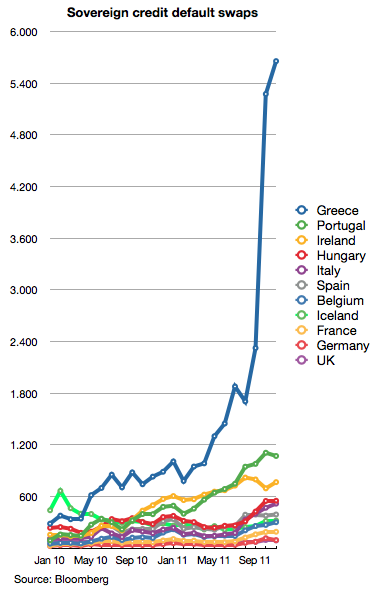 Germany's economy appears to be externally strong (large export surplus as the main motor of GDP growth) but internally it is potentially weak. The banks are vulnerable by having loaned too much to industry (which is paying 10% of value added to service bank debt compared to only 10% of profit in case of UK industry, a nearly tenfold difference!).German banks are desperately in need of cheapest wholesale money (to support narrow margins and cash-flow based collateral) hence the hard attitude against deficit countries' fiscal problems - just a way of making Germany look good to wholesale finance providers relatively by comparison. If external trade shrinks and or becomes less profitable to exporters and if the Euro Area breaks up then Germany faces domestic economy meltdown (worst of all if it returns to a strong and soaring Deutschmark). The Euro Area is in any case now into its recession, a recession that follows as it usually always does 2 years after USA/UK recession. (EU/EA's brief recession in 2008 was not the real thing, only a shock from the financial bank crisis).
 EU politicians have to learn again to kiss their European frog and trust it will turn into a prince again. The USA (Tim Geithner etc.) has very right to criticise the Euro Area politicians for being too reluctant to act in the interest of the whole international community - but he may be foolish to do so publicly. The same may be said of the UK's David Cameron. The Fed, Bank of England and the ECB have a joint responsibility for world money markets and when these seize up they have to intervene jointly. Foreign politician's criticisms - brickbats flung across the Atlantic or across European borders - are usually for domestic political consumption. It is easy to make broad statements but they only make sense when there are concrete ideas to be shared of how best to resolve the problems practically.
It would be a reasonable accusation that the Euro Area fiscal rules are inflexible and simplistic. The Euro had its political supporters but technically was supposed to protect by sheer size against FX-money market speculators. The ECB was set up but placed in a constrained position and consequently fails to sufficiently compensate for the central bank powers that each Euro state gave up to the ECB.
Even the economists internally within the Euro planning teams in Brussels a decade ago foresaw this present disaster. But, back then, they hoped that after the first 5 years new more refined rules and better understanding of the technicalities would have evolved.
This didn't happen for various reasons most of which are political cowardice in face of global FX-money markets - mistakenly believed to be somehow most astute about economics and anyway ultimately all-powerful. The actual dysfunctional nature of information in these markets and their miserable irresponsible short term profit seeking etc. is all beyond the understanding of politicians and even of most political-economists, many of whom get little real-world model-building experience. The bankers also are afraid of economists and refuse to let them into the boardrooms where they fear that economists might take over - preferring instead to deal with the mathematical geeks whose understanding of risk cannot go further than market prices, rating agency ratings, and poorly cultured algorithms.
 Must a new Euro system be legislated? The default direction of travel here currently among EU politicians is to seek a tighter union and tighter rules with a fiscal policing agency. But, practical reality dictates that the EU and Euro Area need less rigidity not more. The Euro sovereign debt crisis is a product of rigid rules and crude definitions of national debt. It is the rigidity that makes it an easy target for shorting speculators.
The irony of the present situation is that the Euro was constructed to protect all members from money market speculators employing rumor-mongering of exaggerated insolvency scares. It is extremely damaging with incalculable repercussions worldwide in medium and long terms to undermine the credit-standing of OECD countries and to threaten the Euro system to generate investor panic for the sake of short term profits.
Any revised or new system must recognise if some EU members insist on maintaining large export surpluses then others must have sizeable external deficits. They cannot all aspire at the same time to export-led growth.
The Maastricht Rules should be elaborated to be made more intelligent, subtler and harder for the markets to analyse and play merry hell with! It does not follow that the answer is fiscal union or sameness within the Euro Area. And fiscal union should not mean aligning all tax and spending. It is not a sensible or workable basis for justifying cross-border financial guarantees. The proponents of more rigidity and fiscal alignment fail to see this course will require large fiscal transfers evey year between Euro Area member states.
 President Nicolas Sarkozy called up Hu Jintao recently to ask if China would care to invest in the European Financial Stability Facility (EFSF), the Eur750bn fund. Sarkozy and Kanzler Angela Merkel are imagining China's US$3+ trillion in foreign exhange reserves as a source of ready cash. Should China say yes?
Of course China should participate because it adds to its mystique as a most successful economic power that is impervious to the crisis elsewhere. This is however not the true case. China is extremely vulnerable. Its economy is considerably smaller than official figures suggest and its economy is starting to nosedive beginning with a property collapse. China's banks are teetering on insolvency caused by funding gap and growing poor and non-performing loans and are only sustained by massive deposits from China's foreign currency reserves. China's industry is massively over-borrowed and very vulnerable to fall in export volume and or profits, already accutely modest.
Europe should not seek China's involvement in contributing to Euro Area crisis funds, or from OPEC countries' dollar reserves either. Such a course would be giving foolish testimony to EU insolvency and internal failure, which is not at all the true state of EU or Euro Area financial resources, which exceed that of China plus OPEC many times over!
The reason China cannot loan a few $ trillion is because its reserves are mainly committed by over $4 trillions to supporting China's domestic banks' balance sheets. Chinese households cannot add much to current deposits and are only permitted to borrow a third back while two thirds of household deposits and all of corporate deposits are lent to industry. There is nearly $5 trillion in loans to China's industrial borrowers in support of which the government has deposited $2 trillion with China's commercial banks and loaned them $2.5 trillions Yes, China has extra pocket change (generated annually from the trade surplus) and could support its trade with Europe more assiduously and politically by directly buying Euro Area bonds including those of the EFSF and or IMF, but probably by no more than a % of its annual trade surplus with the EU totalling perhaps $40 billions in 2011. But, this is a trivial and unnecessary, and for Europe's self-confidence and global prestige hugely damaging - EU's politicians need a wake up call to understand the realities they are playing with.
For quite good succinct discussion on the background see:
http://en.wikipedia.org/wiki/European_sovereign_debt_crisis
Subscribe to:
Posts (Atom)